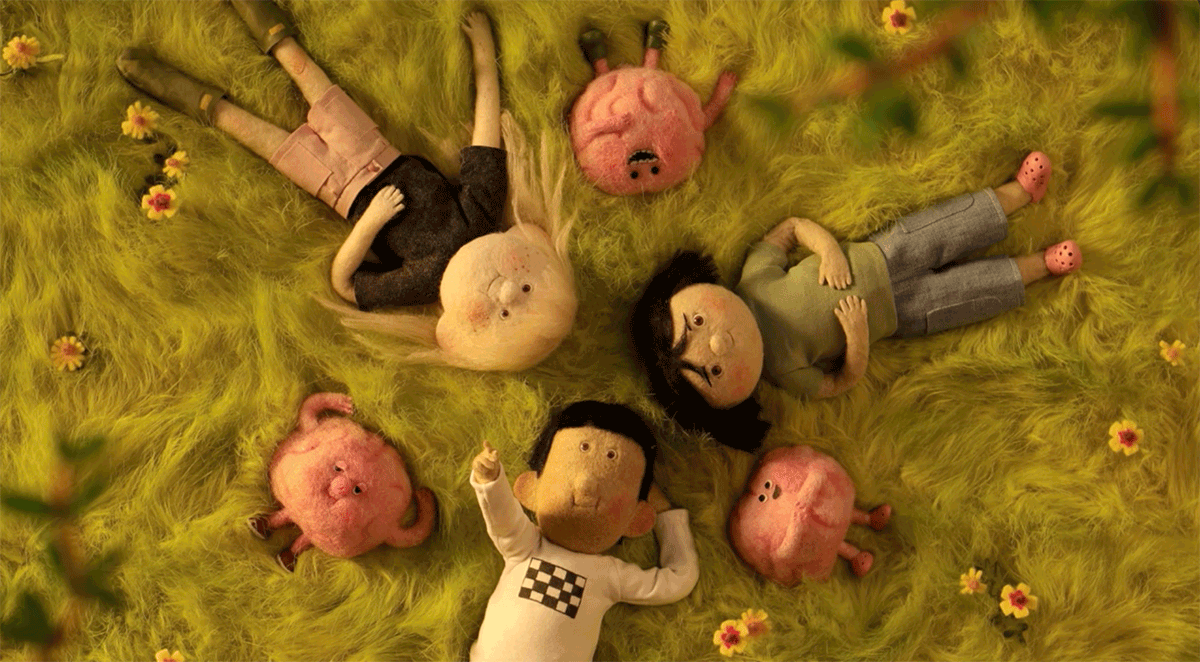



Time outside feels great, we all know that. But the impact of spending time outside? It's much bigger.
Kids are growing up in a world saturated with screens. New research is revealing the impact screen time can have on developing brains, and it's significant. The encouraging part? Nature can help offset its effects.
Time spent outdoors is linked to positive changes in children's brain structure and development. Nature is not only beneficial, it's essential to supporting the development of your child's brain.
So encourage a kid in your life to take their brain out.


Studies continue to show the benefits of time outside, from the backyard to the backcountry. Let's dig in.
When your kid spends too much time on screens, it can overload the part of their brain responsible for focus, decision-making, and impulse control. Over time, that can show up as struggles with attention, communication, and problem-solving.
Time outside does something powerful. It gives this part of their brain, the prefrontal cortex, a chance to rest and reset.
More time on screens, even one additional hour a day, can raise the odds of nearsightedness by 21%. But spending time outside helps reduce nearsightedness onset and slows myopic progression as your child grows. A little more time outside today can make a lasting difference in how your child sees the world.
Higher screen exposure has been linked to more attention difficulties in kids and even altered brain development. Plus, studies show a simple 20-minute walk in a park can improve attention in children with ADHD.
The constant stimulation and multitasking that screens promote can make your child’s brain feel like it’s on overload, which impacts memory performance and executive function. Nature helps recover from that overload, improving their direct attention and memory performance. This means nature supports their learning and problem-solving skills.
Time outside helps recalibrate your child’s internal clock and reset their sleep cycle. The light emitted from screens and devices can suppress their melatonin, the hormone that tells us when it’s bedtime. But sunlight, especially morning sunlight, supports the circadian rhythm. That’s the built-in 24-hour internal clock that regulates when you feel awake or sleepy. So nature regulates sleep timing and improves sleep quality, making zzzzzz easier to reach. Which means a better night’s rest for parents, too.
Spending too much time on screens has been linked to challenges with emotion regulation and social interaction in kids. When kids play outdoors, they experience different types of play that encourage stronger social skills, like communication, cooperation, and peer bonding. It’s not just about interacting with the outdoors, it’s about interacting with people, too.
Ever notice how kids seem different after playing outside? That’s their brain getting a break. The fast-paced digital media that’s delivered by screens can increase cortisol levels, the hormone responsible for stress. Just 20 minutes in nature has been shown to lower stress hormones and calm brain activity. Nature gently resets attention systems so focus comes easier, stress gets lowered, and the chances of a meltdown decrease.
High screen exposure in early childhood has been linked to weaker white matter, the communication network between different brain regions that supports connections involved in language and literacy. But growing up around natural spaces and their sensory input has beneficial effects on brain development and cognitive function.

Dr. Pooja Tandon, MD, MPH
—
General Pediatrician
Health Director, Trust for Public Land
Co-author Digging into Nature


Children & Nature Network
—
Home of the world's largest collection of peer-reviewed literature about nature's benefits for children.

Dr. Joel Stoddard, MD
—
Child and Adolescent Psychiatrist
Children's Hospital Colorado


Scott D. Sampson, PhD
—
Executive Director, California Academy of Sciences
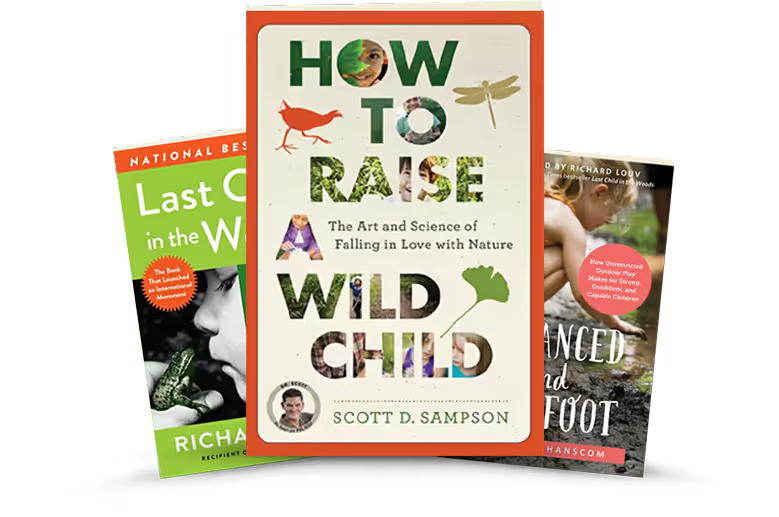
Author, How to Raise a Wild Child: The Art and Science of Falling in Love with Nature
Dr. Pooja Tandon, MD, MPH
—
General Pediatrician
Health Director, Trust for Public Land
Co-author Digging into Nature
Dr. Joel Stoddard, MD
—
Child and Adolescent Psychiatrist
Children's Hospital Colorado
Scott D. Sampson, PhD
—
Executive Director, California Academy of Sciences
Author, How to Raise a Wild Child: The Art and Science of Falling in Love with Nature
1 / 7
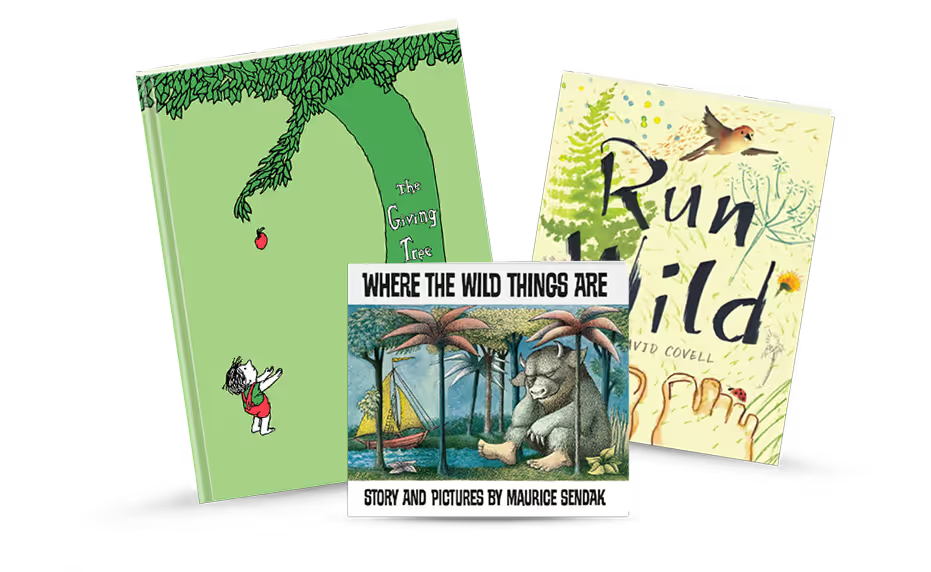
These resources and ideas make it easy to get outdoors with your kids.





Nature gives your child’s prefrontal cortex a break.
Paulus, M. P., Zhao, Y., Potenza, M. N., Aupperle, R. L., Bagot, K. S., & Tapert, S. F. (2023). Screen media activity in youth: A critical review of mental health and neuroscience findings. Journal of mood and anxiety disorders, 3, 100018. Journal of Mood & Anxiety Disorders
Your child’s eyes are still developing. How they spend their time matters.
Ha A, Lee YJ, Lee M, Shim SR, Kim YK. Digital screen time and myopia: a systematic review and dose-response meta-analysis. JAMA Netw Open. 2025;8(2):e2460026. doi:10.1001/jamanetworkopen.2024.60026
Busy brains gain focus outside.
Qiulu Shou et al, Association of screen time with attention-deficit/hyperactivity disorder symptoms and their development: the mediating role of brain structure, Translational Psychiatry (2025). DOI: 10.1038/s41398-025-03672-1
University of Illinois at Urbana-Champaign. (2008, October 15). A Walk In The Park Improves Attention In Children With ADHD. ScienceDaily.
The outdoors flexes kids’ memory muscle.
Uncapher, M.R., K. Thieu, M. & Wagner, A.D. Media multitasking and memory: Differences in working memory and long-term memory. Psychon Bull Rev 23, 483–490 (2016). https://doi.org/10.3758/s13423-015-0907-3Berman, M. G., Jonides, J., & Kaplan, S. (2008). The Cognitive Benefits of Interacting With Nature. Psychological Science, 19(12), 1207-1212. https://doi.org/10.1111/j.1467-9280.2008.02225.x
Sunlight can help your child get a better night’s rest.
Ruder, D. B. (2019, June 19). Screen Time and the Brain. Harvard Medical School.
Summer, J. V. (2025, July 23). How Blue Light Affects Kids’ Sleep. Sleep Foundation.
Nagare, R.; Woo, M.; MacNaughton, P.; Plitnick, B.; Tinianov, B.; Figueiro, M. Access to Daylight at Home Improves Circadian Alignment, Sleep, and Mental Health in Healthy Adults: A Crossover Study. Int. J. Environ. Res. Public Health 2021, 18, 9980. https:// doi.org/10.3390/ijerph18199980
Time outdoors improves social skills.
Fitzpatrick C, Pan PM, Lemieux A, Harvey E, Rocha FA, Garon-Carrier G. Early-Childhood Tablet Use and Outbursts of Anger. JAMA Pediatr. 2024 Oct 1;178(10):1035-1040. doi: 10.1001/jamapediatrics.2024.2511. Erratum in: JAMA Pediatr. 2024 Oct 1;178(10):1086. doi: 10.1001/jamapediatrics.2024.4244. PMID: 39133514; PMCID: PMC11320330.
Rajasekhar Reddy Munamala1, Shaik Mahammad Rafi2, Ramisetty M Uma Mahesh3. (2024). Impact of screen time on social skills development in young children. International Journal of Academic Medicine and Pharmacy, 6(3), 739–743.
Purdue Global. (2025, February 28). The Importance of Outdoor Play in Early Childhood. Purdue Global.
Nature can help lower stress levels.
Afifi, T. (2018). WIRED: The impact of media and technology use on stress (cortisol) and inflammation (interleukin IL-6) in fast paced families. Computers in Human Behavior. https://doi.org/10.1016/J.CHB.2017.12.010
Hunter MR, Gillespie BW and Chen SY-P (2019) Urban Nature Experiences Reduce Stress in the Context of Daily Life Based on Salivary Biomarkers. Front. Psychol. 10:722. doi: 10.3389/fpsyg.2019.00722
Green spaces support the brain's white matter.
Jean M. Twenge, W. Keith Campbell, Associations between screen time and lower psychological well-being among children and adolescents: Evidence from a population-based study, Preventive Medicine Reports, Volume 12, 2018, Pages 271-283, ISSN 2211-3355, https://doi.org/10.1016/j.pmedr.2018.10.003
Hutton JS, Dudley J, Horowitz-Kraus T, DeWitt T, Holland SK. Associations Between Screen-Based Media Use and Brain White Matter Integrity in Preschool-Aged Children. JAMA Pediatr. 2020;174(1):e193869. https://doi.org/10.1001/jamapediatrics.2019.3869
Dadvand, P., Pujol, J., Macia, D., Martínez-Vilavella, G, Blanco-Hinojo, L., Mortamais, M., Álvarez-Pedrerol, M., Fenoll, R., Esnaola, M., Dalmau-Bueno, A., López-Vicente, M., Basagaña, X., Jerrett, M., Nieuwenhuijsen, M., Sunyer, J., (2018). The association between lifelong greenspace exposure and 3-dimensional brain magnetic resonance imaging in Barcelona schoolchildren. Environmental Health Perspectives Lifelong Greenspace Exposure